
Cosmetic Breast Augmentation: How It Works and Who Should Avoid It
Most worries before cosmetic breast augmentation are not about whether the result looks good, but about two unspoken questions: will there be complications, and am I being misadvised into buying an expensive implant that is not truly right for me. These are legitimate concerns. In reality, placing a breast implant is a medically standardized plastic surgery procedure with a clear scientific basis and well-managed risks when it is performed according to sound anatomical principles, with the right materials and on the right candidate. This article is not here to sell you a breast shape, but to explain the technical fundamentals so that you can decide based on understanding.
The science of cosmetic breast augmentation: it all comes down to the implant pocket
The safety of a cosmetic breast augmentation procedure is determined largely by one question: which anatomical pocket the implant is placed in, not the implant brand. There are three main options, and choosing correctly depends on the thickness of the glandular tissue, the elasticity of the skin and the degree of sagging.
The subglandular placement (above the pectoralis major muscle) gives fullness quickly with less pain, and suits people with sufficiently thick tissue coverage. The submuscular placement (beneath the pectoralis major) increases coverage of the upper pole and reduces the risk of visible implant edges in thin patients with little tissue. The dual-plane technique combines both layers, providing good coverage of the upper portion while letting the breast gland drape naturally over the lower pole; it is often the balanced choice.
Choosing the right layer helps the breast shape hold up better over time, lowering the risk of implant visibility, rippling and early sagging. A specialist will measure the rib cage and assess tissue and skin first before selecting the pocket, rather than applying one fixed formula to everyone. This personalized approach is the foundation for a result that is in harmony with your body.
Implant materials: understanding Mentor and Motiva correctly
The materials, too, need to be decoded correctly. The Mentor line offers Xtra (oriented toward projection and fullness) and Boost (defining the upper pole). Motiva Ergonomix 2 uses a SmoothSilk shell together with ProgressiveGel, giving a soft, natural drape as you change position. Both lines have received U.S. FDA approval for their materials, which you can verify yourself through the product code.
To be candid: there is no implant that is better than another in an absolute sense. Choosing the line and size must be based on the structure of the glandular tissue, the skin's elasticity, the rib cage and each person's aesthetic preferences; a more expensive implant does not mean it suits you better. This is where the surgeon's skill and honesty make the difference: choosing the right material for the right anatomy helps optimize a natural feel and long-term stability.
Myth-busting: the costly misconceptions around breast augmentation
The most common belief that leads many cases to fail is "the bigger the implant, the more beautiful". In terms of soft-tissue mechanics, this is wrong. An implant that is oversized relative to the rib cage and the skin's load-bearing capacity creates a weight that exceeds the tissue's ability to support it, leading to early sagging, implant visibility, edge rippling and prolonged tightness and pain. The appropriate size must be proportional to the bone framework and skin quality, not the largest number you wish for.
The second misconception: "once the implant is in, the shape stays the same forever". In reality, the breast is still subject to gravity, weight changes, pregnancy and tissue aging; how long the result lasts depends on individual factors and care, and is not permanently fixed. The third misconception: "the faster and more pain-free the surgery, the more skilled the surgeon". Any intervention involving a skin incision causes some post-operative sensation; what a good team can do is actively control pain with a pain-management protocol, not promise that it will be pain-free.
Something low-quality facilities often hide is the origin of the implant and the implant placement layer. When there is no transparency about whether the implant is genuine, or when it is placed in the wrong anatomical pocket, the risk of complications rises significantly. The solution is very clear: ask to know exactly which implant line, the product code, and the reason for choosing that pocket for your anatomy. Understanding these myths correctly helps you save on the cost of corrective surgery and protect your health.
Medical notes: who should avoid it, and which side effects are normal
This is the most important part for you to make an honest decision with yourself. Some cases call for contraindication or considered postponement:
- Currently pregnant or breastfeeding.
- Having an uncontrolled blood-clotting disorder.
- Having an active, progressing infection.
- Having a breast condition that has not been fully screened.
- Having an unstabilized underlying condition (cardiovascular, diabetes, autoimmune).
- Holding unrealistic expectations about the result.
- Being a heavy smoker, as it affects the wound-healing process.
As for complications you should know about, though they are not common: capsular contracture (fibrous capsule tightening around the implant), seroma or hematoma after surgery, infection, and changes in nipple sensation. For this reason, having the procedure done at a facility with a sterile operating room and close post-operative monitoring is a safety factor that cannot be overlooked. If you experience increasing swelling, warmth and redness, fever or unusual pain, you should contact your doctor immediately.
On the other hand, there are normal side effects you should be mentally prepared for: swelling, tightness and bruising typically appear and then gradually subside over about 2–6 weeks. This is part of the natural recovery process, not a sign of failure. Post-operative pain is actively managed with a pain-control protocol, and how long the aesthetic result is maintained still depends on each person's individual makeup and their subsequent care.
The medically standardized process and why you should choose a specialist
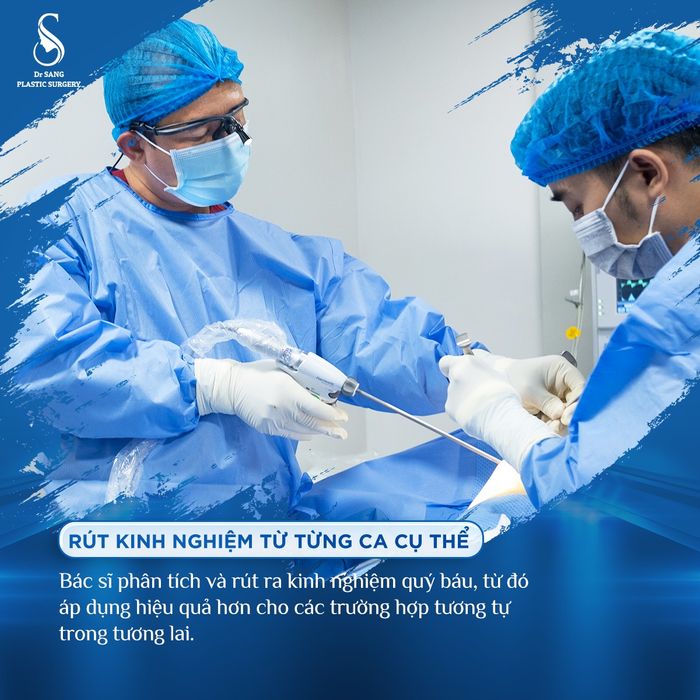
Safe breast augmentation is not just a single operation, but a process. At Dr. Vo Thanh Sang's unit, each case is personalized: measuring and assessing the tissue, skin and rib cage before selecting the implant line and pocket; carrying out pre-operative tests; performing surgery in a sterile operating room at an accredited hospital, never at a spa or beauty salon. The materials are genuine breast implants with clear product codes for you to cross-check.
Trust lies in the details: the specialist personally examines, advises and operates, without handing off the technical part to others; close post-operative care; costs quoted per case, transparent before you decide. The surgeon's skill is an important factor that helps optimize the chances of success and supports recovery, although the final result still depends in part on each person's individual makeup.
Conclusion
A beautiful and lasting cosmetic breast augmentation does not come from the largest or most expensive implant, but from choosing the right anatomical pocket and the right material for your anatomy, performed within a medically standardized process. Clearly understanding the mechanism, the complications and the cases that should be avoided is the best way to protect yourself.
If you are considering cosmetic breast augmentation, please register for a direct consultation with a specialist to receive a free structural and anatomical screening before you decide. Contact Dr. Vo Thanh Sang — Head of the Cosmetic Surgery Unit, World Wide Hospital, 244A Cong Quynh, District 1, Ho Chi Minh City — via the hotline 079 7479 222 for an honest assessment and a listening ear.